Juries vs Citizen Assemblies

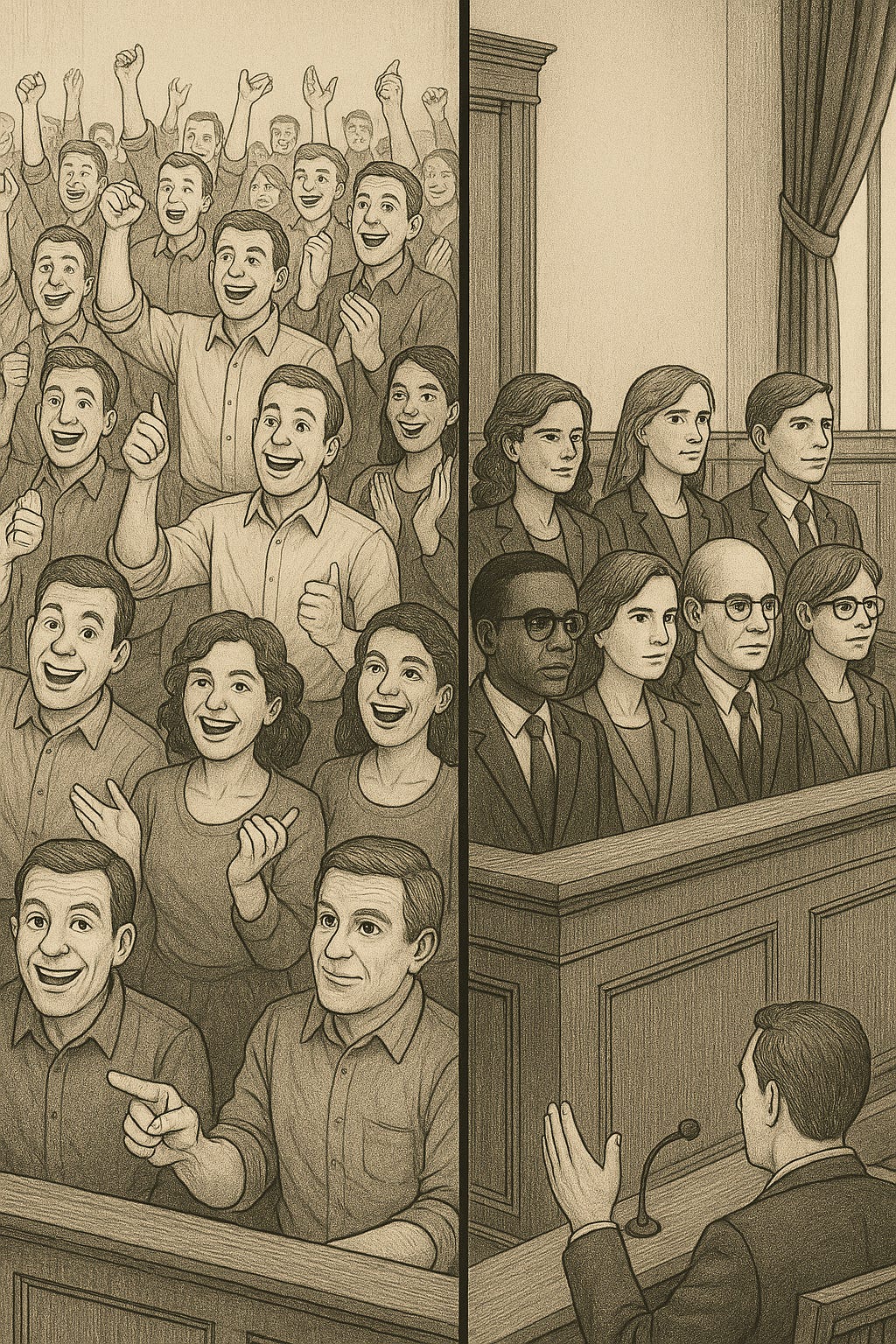
We at Election By Jury (EBJ), believe that our political representatives (ie, mayors, governors, senators etc) should be elected by a jury in a courtroom-like setting (see here for more details). Anyone familiar with the sortition movement would notice that this idea has many parallels to a similar idea known as Citizen Assemblies - an idea that has already found some traction in places like Ireland. To review some key similarities, both ideas revolve around:
Using a lottery to randomly select the people who will make up the jury/assembly
The jury/assembly spends a large amount of time collectively learning more about the topic being discussed
After extensive knowledge sharing and deliberation, the jury/assembly make their decisions, which will directly or indirectly shape government and public policy
These similarities are indeed very profound and significant. Hence why many EBJ advocates are also in favor of citizen assemblies. However, there are some key differences between them that are worth discussing.
Disclaimer: there is no authoritative definition of how a Citizen Assembly should be run. Indeed, you can even choose to run a Citizen Assembly in a way that would render it identical to an Election By Jury. For the purposes of this article, we are going off the Citizen Assembly norms described here in the Harvard Political Review.
Under sortition, legislative bodies are called “citizen assemblies.” They function like legislatures but are composed of randomly selected citizens
Let’s start off with the foremost philosophical difference between them. EBJ advocates for legislative bodies being filled by jury-elections. Ie, using a jury to elect your representatives in Congress or Parliament, in addition to other elected positions like Mayors, Governors etc.
Whereas Citizen Assemblies are envisioned as a legislative body in itself. Ie, you wouldn’t use a Citizen Assembly to elect your senators. Rather, the assembly is the senate.
Even if Juries and Assemblies are procedurally very similar, you can immediately see how the above makes a big difference. Legislative bodies have an extremely wide scope of responsibilities. They have to debate and pass public policy bills, on a wide variety of topics. They also have to provide oversight for a large number of governmental bodies. Can a group of randomly chosen people fulfill these responsibilities just as well as society’s most trusted leaders? Should a single group of lottery winners wield so much power over such a broad range of issues, and be expected to step away from their careers and day-to-day lives for such a long period of time?
Juries, in contrast, fulfill a much simpler and more straight-forward role. Each EBJ jury is only responsible for determining the outcome of a single election. For electing a leader who is competent and can be trusted. Once that is done, in a matter of weeks, the day-to-day business of legislating and running the government would be in the hands of the elected leaders.
The above also demonstrates a significant difference in worldview. EBJ supporters believe that good capable leaders exist - we simply need better ways of identifying them and electing them into office. Whereas Citizen Assembly supporters believe that politics will inherently attract those who are corrupt, narcissistic, or power-hungry - hence, even a randomly chosen person would be better than anyone who nominates themselves for public service.
A nonpartisan advisory body picks an issue for the citizen assembly to legislate.
Of course, it can be risky handing over the keys to the kingdom to a group of randomly chosen people. For starters, there are numerous different responsibilities that assembly members have to juggle. And numerous internal disagreements and power-struggles that assembly members will have to resolve, in order to even decide which topic to take on next, and sort out other procedural decisions.
This is why citizen assemblies have delegated significant power to a “nonpartisan advisory body” which decides the topics the assembly will even spend its time discussing. Of course, this raises concerns of its own. Who selects the members of this advisory body? What mechanisms will ensure that this body selects topics that reflect the wishes and needs of the people?
There are indeed various ways of tackling this problem. For example, by having the assembly itself choose its advisory body. But regardless, this delegates a tremendous amount of legislative power to a 3rd party. One that may have been hastily chosen by an assembly juggling numerous competing responsibilities.
Juries in contrast, have a far easier time resolving such logistical debates. A jury would be automatically convened anytime there is an election. And each jury is narrowly focused on making a single decision - the outcome of the election they were convened for. Such static and well-defined procedures minimizes the potential for bias.
Once a degree of consensus is reached, the assembly members begin drafting policy with consultation from the experts.
The distinction between juries and legislative bodies becomes even more stark when you consider their responsibilities. Juries are tasked with choosing between a small set of options. In EBJ, the jury has to elect one representative from a short list of candidates. Even if you used juries for something like a ballot initiative, they can only vote yay or nay to each proposal.
In contrast, Assemblies are relying on their randomly chosen members to not just vote for one of many options… but to draft an entire piece of legislation. To put this in perspective, the legislation for the Affordable Care Act is a whopping 906 pages. A citizen assembly would be required to not just vote on such legislation… they would also need to draft the entire 900+ page text.
Yes, they will be given “expert consultation”. But what does this practically mean in the context of drafting a 900 page legislation? Who chooses the experts? Do the experts do most of the writing themselves, on behalf of the assembly? There are thousands of small decisions that need to be made in the process of drafting a 900 page legislation - how do these thousands of decisions get resolved in a body composed of 100 randomly chosen lay people?
Once an assembly is convened, its members are introduced to the issue being legislated by a variety of experts, from academics to professionals to activists.
Anyone who has watched a courtroom drama has an intuitive sense of how jury-elections would work. Each candidate (or their “courtroom representative”) would make their opening and closing statements, explaining why they should be elected. They can take the stand themselves, or call upon other witnesses, to attest to their personal character and history. They can submit evidence and call upon expert witnesses to testify on behalf of their public policy accomplishments and proposals. They can also cross-examine other candidates and their witnesses, in order to expose any flaws or inconsistencies in their testimony.
All in all, each side is given the opportunity to present their case in the strongest possible manner, and to poke holes in the other side’s case. And because each side is represented by its fiercest champions, they are motivated to present the strongest case possible. With each side being given an equal opportunity to make their case, this leaves minimal room for bias.
Contrast this with the citizen assembly described above. The assembly listens to presentations from a “variety of experts”. But who chooses these experts? The prior mentioned “nonpartisan advisory body”? What prevents this body from choosing a panel of experts who are, on aggregate, more biased towards one viewpoint? Whoever is in charge of choosing the experts, also has the ability to massively influence the outcome of the assembly.
This can even happen purely inadvertently. For example, suppose the experts were themselves chosen by a randomly chosen citizen assembly, to prevent the possibility of external bias. Because each side doesn’t get to make their own case and present their most compelling experts, the assembly can unintentionally hamstring one side by picking less-compelling experts for their side. Not to mention the risk of assembly members’ pre-existing biases leading them to pick more experts for one side than the other.
The assembly members then have discussions about the issue moderated by a neutral “discussion leader.”
Notice also that the assembly members have extensive discussions that are “moderated by a neutral discussion leader”. If the discussion leader is anything like most discussion leaders/facilitators/moderators, they take a very active role in the discussion. They asked pointed questions to guide the discussion in certain directions. They rephrase and summarize what others have said. They call upon people who may not even have their hands up. All in all, they wield a great deal of power.
Which once again raises the question: who selects this “neutral discussion leader”? Given how cut-throat politics is, do we really think that the people in power will choose a “neutral” discussion leader, instead of someone they agree with? Given how biased all individuals are, do we really think that any discussion leader will prevent their personal opinions from influencing the thousands of subjective micro-decisions they have to make constantly while facilitating and guiding a discussion?
Yes, jury-courtrooms are also run by a judge who can very loosely be described as a “courtroom moderator”. But unlike a “discussion leader”, judges do not ask jurors pointed questions to guide the discussions in certain directions. Judges do not ask specific jurors for their opinions, nor do they rephrase and summarize what they have said. For the most part, judges’ interactions with the jurors are extremely limited - they are mostly focused on ensuring that the right procedural rules are being followed. With such limited involvement, a biased judge poses far less danger to a jury-election, than a biased discussion leader in a citizen assembly.
—
Don’t get me wrong - our current system of mass-voting is so rife with ignorance, misinformation, and echo-chambers, that citizen assemblies would still be a tremendous improvement. A citizen assembly with biased moderation would be far superior to the shallow money-driven popularity contests that pass for elections today.
As I’m sure you’ve guessed however from the above write-up, I see more potential in jury-elections than in citizen assemblies. But maybe I’m biased? In true Election-By-Jury fashion, I invite my fellow Citizen Assembly advocates to make their own case for why Assemblies are preferable to Jury Elections.
—
Written by Rajiv Prabhakar. All opinions expressed above are mine alone.
I largely agree but I want to defend the assembly process on some points.
"But who chooses these experts? The prior mentioned “nonpartisan advisory body”? What prevents this body from choosing a panel of experts who are, on aggregate, more biased towards one viewpoint? Whoever is in charge of choosing the experts, also has the ability to massively influence the outcome of the assembly."
I think this overrates the effect of bias and underrates the truth-seeking ability of the assembly. The outcome of a decision isn't just a calculation of which side had more bias towards it. The greater the truth-seeking ability of an entity, the more stronger the level of bias required to successfully influence it. The design of the deliberative process used by most assemblies is meant to maximize truth-seeking and thus isn't easily influenced by modest amounts of bias. There are examples of this in action, such as in the French assembly on climate, where the government did try to send biased experts to try to get the assembly to go along with their position and it was unsuccessful.
Also, if elector juries are suitable for choosing judges and legislative experts, I think they are probably suitable for choosing discussion facilitators too.